
My Machine Learning Learning Journey – Stanford CS229 Insights
Started: 2025-12-01
About this project
🎓 My Machine Learning Learning Journey
Student: Leon Motaung
Technologies Covered: Python, NumPy, Pandas, Linear Algebra, Statistics, Machine Learning Theory
📘 Course I Studied
I began my formal Machine Learning learning by studying one of the most famous ML lectures in the world:
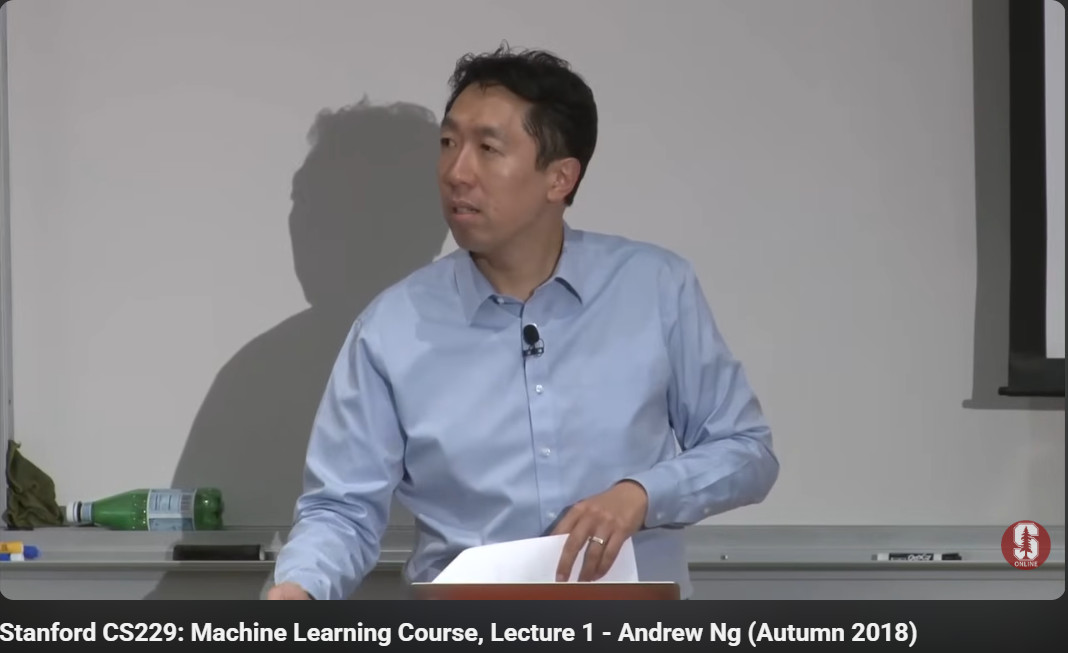
Stanford CS229: Machine Learning – Lecture 1 (Autumn 2018)
Taught by Prof. Andrew Ng – a globally recognized AI researcher and Co-founder of Coursera & DeepLearning.AI.
👨🏫 Professor Highlight
Professor: Andrew Ng
Adjunct Professor of Computer Science at Stanford University.
One of the pioneers of modern AI and Machine Learning.
His lecture provided a deep foundation for understanding ML systems.
📺 Key Topics from Lecture 1
- Introduction to Machine Learning
- Applications of ML in real-world systems
- Supervised vs. Unsupervised Learning
- Regression & Classification
- Reinforcement Learning overview
- The importance of data in ML
- ML as a combination of statistics + algorithms + data
🧠 Concepts I Learned
- ML is about learning patterns from data
- Supervised Learning: uses labeled data (e.g., predicting price or category)
- Unsupervised Learning: finds hidden patterns (e.g., clustering customers)
- Feature engineering plays a massive role in accuracy
- Data preprocessing is crucial — ML is 80% data cleaning!
- Understanding loss functions & model evaluation (RMSE, accuracy, etc.)
🧮 Mathematical Foundations
To understand ML deeply, I also started revising:
- Linear Algebra – vectors, matrices, dot products
- Calculus – derivatives & gradients for optimization
- Probability & Statistics – mean, variance, distributions
- Optimization – gradient descent & cost functions
🧭 My Next Steps
- Implement Linear Regression from scratch using Python
- Practice supervised learning projects
- Learn Logistic Regression and Classification
- Follow CS229 assignments and notes
- Start building my own ML portfolio
🔥 This course gave me a strong foundation and a clear direction in Machine Learning. I now understand the mathematical and real-world side of ML — and I’m ready to build more!